Veterinarians choose their profession carefully. We have to put a lot of stress, sweat, tears, time, and money into getting our education, and few go into this lightly. For most vets it's a passion as much as a career choice. And even for those who may sometimes regret the choice and wonder "what if", there is still a strong attraction for the work.
But that doesn't mean that we love every day and feel strongly motivated at each moment. Here's something that may be surprising to many clients and veterinary students: sometimes doctors don't want to be at work. Sometimes we don't want to see patients and have to struggle to get through the day, watching the clock until it's time to go home. And sometimes we're simply bored and tired of doing the same thing over and over. How many times in a week do I have to discuss ear infections and weight problems?
This doesn't mean that we necessarily take short-cuts in our care, or avoid patients. But it does mean that some days we have to work harder to fake a smile or interest. Client service is a very important aspect if veterinary medicine, and that means we have to try out best to give our best with every single person. However, sometimes we just don't "feel" it. And some vets are better at putting on this mask than others.
Surprising to some? It shouldn't be. After all, being a vet is a job not dissimilar from other jobs. And I don't think there is anyone out there who doesn't feel this way about their own jobs at times (or frequently). It's tempting to think that people in a healing profession are always motivated and eager to do what we do. However, we're just as human as our clients, and have the same weaknesses.
Yeah, I'm quite unmotivated today. But life goes on, work goes on, and the clinic will open tomorrow whether or not I'm ready for it. So I'd better be ready!
Tuesday, July 5, 2011
Saturday, July 2, 2011
Picking A Vet School
Lauren emailed me with the following...
I currently live in Phoenix (worst place ever for a vet major since CSU is beyond difficult to get into). I have about 1.5 years left in undergrad work and was applying to schools out of state as a transfer to finish up. I am looking into schools that already have vet programs to increase my odds (I’ve done a lot of research on this and have figured out my odds of being instate for each school in the US). I have eliminated several schools based on location and difficulty as I don’t want to set myself up for failure. I have currently applied to Iowa State, Oregon State, and Louisiana State. I know I’ve already been accepted into Iowa State and am waiting to hear from the other 2. With that said, there were also 3 other schools I was looking at (Purdue, UT, and Washington State). Those applications are not even available until August 1st. My questions are – in your opinion, is it a smart move for me to do this? I am basically putting all my eggs in one basket, but staying in AZ makes it nearly impossible. Also, if I decide to apply to the other 3 schools I won’t even hear back until mid October and I’ll be mid way through a semester at school. Should I just decide on one of the 3 I have already applied to so I can make a plan for my move for January and start looking into housing options, loans, scholarships, jobs etc now while I’m not in school and not stress about that during a very difficult semester to come? I feel a strong pull toward Iowa State. I’ve had many signs from God telling me that is where I’m needed, but I also want to be as smart about this as possible and do as much research as I can to benefit my end result. I don’t know anyone at that school so I’d be leaving everything I’ve ever know in AZ which is terrifying. I’d really love to hear from someone who has gone through this stress and decision making process to know if I am being smart and reasonable about this. I have good grades, I volunteer with a no-kill rescue, I have worked as a tech at a specialty and emergency hospital, so I feel pretty confident about those areas, just unsure of taking the final leap.
Definitely looks like you're planning ahead! I do have a few bits of advice that may help your decision.
First of all, be VERY certain that you know what each school requires to get in-state status. I went to the University of Tennessee for my Master's degree, and planned on going to UT for vet school since I was already there. However, much to my dismay I learned that the admissions department still considered me an out-of-state student because I had come to Tennessee to attend school. It didn't matter to them that I had lived in the state for two years, paid taxes, had my car and driver's license in the state, and was by all other definitions considered a Tennessee resident. They told me that I would have to live in the state for at least nine months without attending classes before they would consider me an in-state resident for school purposes. It is much harder to get accepted into a veterinary school as an out-of-state student, so this will need to weigh in your decision. Additionally be aware of which credits will transfer. You may go to a different school and discover that you have to take many classes over again because the new university doesn't accept the grades and credits from Arizona. Before saying a final "yes" be very, very certain of how all of this will affect your credits, residency, and future chances for veterinary school.
It's never a bad idea to apply to multiple schools, as you may be declined at one and accepted at another. But it's unrealistic to apply to a dozen or so, especially with moving costs. It's great that you've already been accepted at Iowa! This really helps, as you have something to fall back on if the others don't work out. But if you have to accept Iowa's offer before you are able to apply the others or would hear back from them, I would go ahead and say yes to them so that you don't miss out on that chance.
If you're uncertain about which school to choose, especially if you are accepted at multiple ones, sit down and make a list of all of the pros and cons of each one. Look at what you might want to do once you graduate (realizing that many people change their minds several times during vet school), and see which college might give you the best training or edge in this area. Don't forget to list the pros and cons of non-collegiate aspects such as weather, local activities, people you know, etc. Honestly, these "fuzzy" factors can be just as important as the actual education since you'll be living there for at least four years.
Here's another hint that might be a bit scandalous. Don't worry about the school's national ranking! Seriously. When I'm looking at a new graduate I really don't care what school they've been at, and most employers are the same way. If you've graduated and been licensed, then you're a veterinarian. I've seen good and bad vets from most of the schools, so the college on the diploma really doesn't matter to me much. Pick a school for reasons other than ranking.
I also wanted to address another thing that you mentioned...you feel that God is directing you to Iowa. I don't often mention religion in this blog, but I'm a conservative Christian, active in church and ministries, and the will of God is very important to me. If you feel through prayer and meditation that God wants you in Iowa, then to me that's the single most important factor. If that's His desire and plan for you and you try to go somewhere else you will have a harder time. God gives us intelligence and reason and we shouldn't ignore these, but He wants us to listen to Him even more. Pray about it and listen closely to Him and you will find your answer. "Trust in the Lord with all your heart and lean not on your own understanding. In all your ways acknowledge Him and He will make your paths straight." (Proverbs 3:5,6)
Best of luck to you, Lauren!


Friday, July 1, 2011
Rats!
My daughter is eight years old, and really loves animals. That's not unusual for little girls, but what sets her apart is that she likes the odd animals that most girls her age run away from. She loves our bearded dragon, thinks creepy-crawly critters are cool, and for the past year has wanted a pet rat. Her interests are a bit of a challenge in our family, as my wife doesn't have a soft-spot for such animals, and has been reluctant to have them in our home.
Elena gets her passion for exotic pets honestly...I also love them and have encouraged her interest. I have long known rats to be very good pets who are intelligent, generally friendly, and easy to care for. They are my favorite rodent pet, and I find them to be far better than hamsters or gerbils. Unfortunately many people can't get away from the stigmas of rats: they carried the plague-ridden fleas into homes that lead to the Black Death in europe; they are found in sewers, trash dumps, and other unseemly places; they get into grain stores and contaminate them; etc. There is also something about that long, naked tail that people find repulsive. All of this "bad press" makes it hard for people to really look at them and see them for the great pets they can be. Additionally, pet rats are a different species from the rats most people think of as causing disease and problems.
Finally my wife relented, and agreed to allow our daughter to have her own pet rat. However, we required her to save her own money to buy the rat and the accessories necessary. It took some time, but she did finally save her allowance and gift money to the point of being able to get her first rat. A couple of weeks ago we went to the store, picked her out and brought her home.
Adara (named after the main character in the book The Ice Dragon by George R.R. Martin, which my daughter loves) is a real sweetheart. She is everything I could want in a pet rat, being very friendly and handleable. Elena is being a great pet owner, keeping up with food and water, handling her gently every day, and helping to clean out her tank. She is very proud of her little rat, and understands the responsibilities that go with the fun of having a pet.
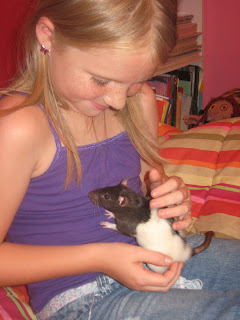
 There was one thing we didn't anticipate about the new pet. One of our dogs, Inara, is very, very fascinated by Adara (yes, we like uncommon names for our pets). We have to be careful not to leave Elena's bedroom door open because Inara will go on there and try to climb up on the desk where the rat's tank is kept. She's not aggressive and doesn't growl, bark, or act like she wants to attack her. She's simply very interested in our new family member.

 Adara sometimes is just as interested, looking out and sniffing at Inara. Unfortunately, I haven't been able to get a picture of that particular scene, as they move away before I can get my camera up! It's a brief but incredibly cute interaction.
My beautiful, wonderful wife has been working on overcoming her dislike of these pets, allowing both me and our daughter to fulfill our dreams and have these non-traditional pets. However, she refuses to have anything to do with them and set the stipulation that Adara is never to leave my daughter's bedroom.
And yes, my daughter's room is VERY pink! Just how she likes it.
Elena gets her passion for exotic pets honestly...I also love them and have encouraged her interest. I have long known rats to be very good pets who are intelligent, generally friendly, and easy to care for. They are my favorite rodent pet, and I find them to be far better than hamsters or gerbils. Unfortunately many people can't get away from the stigmas of rats: they carried the plague-ridden fleas into homes that lead to the Black Death in europe; they are found in sewers, trash dumps, and other unseemly places; they get into grain stores and contaminate them; etc. There is also something about that long, naked tail that people find repulsive. All of this "bad press" makes it hard for people to really look at them and see them for the great pets they can be. Additionally, pet rats are a different species from the rats most people think of as causing disease and problems.
Finally my wife relented, and agreed to allow our daughter to have her own pet rat. However, we required her to save her own money to buy the rat and the accessories necessary. It took some time, but she did finally save her allowance and gift money to the point of being able to get her first rat. A couple of weeks ago we went to the store, picked her out and brought her home.
Adara (named after the main character in the book The Ice Dragon by George R.R. Martin, which my daughter loves) is a real sweetheart. She is everything I could want in a pet rat, being very friendly and handleable. Elena is being a great pet owner, keeping up with food and water, handling her gently every day, and helping to clean out her tank. She is very proud of her little rat, and understands the responsibilities that go with the fun of having a pet.


My beautiful, wonderful wife has been working on overcoming her dislike of these pets, allowing both me and our daughter to fulfill our dreams and have these non-traditional pets. However, she refuses to have anything to do with them and set the stipulation that Adara is never to leave my daughter's bedroom.
And yes, my daughter's room is VERY pink! Just how she likes it.
Sunday, June 26, 2011
The Other Side Of Pet Ownership
There's often something that pet owners don't consider when they get a pet, especially if they have multiple pets. Cleaning! Pets can be loving, fun, interesting companions, but they can't pick up after themselves. Which means that we the owners get to do that. And yes, I had a big day of doing that today, which is why this came to mind.
Today I had to clean a betta tank, remove and replace bedding in a rat tank, clean the cats' litter box, and clean out the bearded dragon tank. Doing all of that took me the better part of an hour, and wasn't the most pleasant work. However, in the mini-zoo we have in our house it's a necessity and one you can only put off for so long before conditions get unhealthy.
I'm not sure many people consider this less-than-pleasant aspect of having animals in the home. You have to clean up waste, keep them clean (I had to give my beardie a bath today), and pick up messes that they may make with chewing and scratching around the house. Pets are still less maintenance than children, but they aren't completely maintenance-free. This is especially true with caged pets such as birds, rodents, and reptiles where you have an enclosure that must be cleaned and you can't train them to eliminate in a specific place.
Still, it's an acceptable trade-off as far as I'm concerned, and the price we pay to have the joy of pets around us.
Thursday, June 23, 2011
No More Declaws
One of my earliest posts on this blog was on the pros and cons of declawing, posted back in November 2008. At the time I had a good discussion, partially by email, with one of my UK readers on the good and bad of it. At that time, I didn't like the procedure but was willing to do it. Well, I have to say that since then my opinion has changed.
It's interesting how you can think about things differently as you get older and have different experiences. When I first graduated from vet school I had no problems with declaws, seeing it as a routine procedure and not harmful to cats. I even had my own cat declawed before I started vet school. As I practiced and performed this surgery, I started to realize that it was uncomfortable and had a higher risk of complications compared to other surgeries. However, I continued to do it, though I started to more openly stress the potential problems. Fast forward a few more years and I had read more articles on how cats don't walk the same afterwards (even though it may not be noticable to the naked eye), pain control was more important, and it was illegal in many countries. So I started really trying to talk up the bad parts of declaws and convince clients not to do it without just saying "don't do it". I still saw it as a better option than ending up at a shelter because of destructive clawing.
My first major turning point was just after my blog post in 2008. In the discussion with the reader, she pointed out that we don't de-bark dogs that are constant barkers because it is unethical. Clawing is a natural behavior of cats just like barking is a natural behavior of dogs. If we de-bark dogs, we're treating a behavioral problem with surgery, and the veterinary community as a whole has a consensus that doing that surgery is unethical. It was a bit of a surprise as I realized the hypocricy of my declaw position...I was okay with doing it, yet I was ethically opposed to a comparable procedure in dogs. I was using surgery to correct a behavior, and this went against my views as someone with a strong interest in behavior.
Even then I didn't stop doing declaws, though I was increasingly uncomfortable with them. Over the next couple of years I starting having more post-operative complications in this surgery, mostly with cats getting their bandages off and the paws bleeding. It was never life-threatening blood loss, but it certainly looks horrible and is a mess to clean up, and I hated thinking how my patients felt that would make them uncomfortable enough to really pull at the bandages. I modified my technique, trying every method I knew of to remove the claws and seal the incision, short of a laser (which I've never had access to). Almost 12 years of doing declaws with minimal problems and then it seemed like every second or third surgery had issues. I began to really, really dread whenever I had to do the surgery.
Finally, about four months ago I decided that I had simply had it. The more I thought about it the more I had problems with the "necessity" of declawing cats. Yes, I know they can be destructive. I have three cats of my own, all with claws, and we have claw marks on furniture to prove it. However, I would never de-bark a dog because of barking, or declaw a dog, rabbit or other animal because of destructiveness. I would never do a full-mouth tooth extraction in a pet to prevent damage when biting. There are serious ethical problems with each of these. So why would I be comfortable doing a declaw? I decided that I wasn't. And I told everyone that I would never do one again.
I'm actually very comfortable with my decision, and haven't seen it affect my practice at all. It makes me feel more comfortable as a vet in how I care for my patients, and gives me a sense of relief that I never have to deal with the complications in my own patients. I also have swung to the other side of the debate, and wonder how others can easily do the surgery without consideration for all factors and without considering the stance on similar procedures that we won't do. I think that declawing in the US has become so commonplace that many vets never really think about the ethics behind it and what we're really doing to the cats. I'm not going to condemn my colleagues who still do the surgery as I remember what I thought years ago and I want people to come to decisions themselves. But personally I would have no problem at all with it becoming illegal in the US.
Sunday, June 19, 2011
Career Choices Know No Borders
Let's close out the week with another international reader...
My name is Aina Kamaruzaman and I'm a veterinary student of the newly vet school in Malaysia (the 2nd vet school apparently) and are moving to third year this september. I've been following your blog and I read your post about foreign graduates. I have no intention to work overseas rather than study (because I want to serve Malaysia due to the shortage of vets here) and I have few questions for you since you are the senior vet and probably can understand a typical vet student like me.
1) We are the smallest vet faculty in Malaysia (established in 2008) and we are the pioneer batch for the faculty. How to get ourself in the same level as other vet students in the more established universities because some people (even in Msia) probably wouldn't notice us as vet students. And how do we can promote ourself being recognize internationally so that people worldwide know our existence?
I'll admit to not having a clue on this part, though perhaps my readers might. Also, this is more the duty of your school's administrators than it would be for you and your fellow students. As students, you don't have ways to get connected within the international academia community as easily. One possibility might be to talk to students in vet schools outside of your country and work out an informal exchange program, spending a week or two with them and then having some of those students come to Malaysia to see your facilities.
2) I am moving into third year but still do not know which field I'm going to be involved with when graduated. I've been exposed to field work, ruminants, non-ruminants, horses, small animals, zoos, clinical and laboratory works but still couldn't make up which to choose. Is it normal for a third year student like me have this problem?
Now this I can answer! Aina, this is actually a very common situation for many students, regardless of where you're going to school. When I was a veterinary student I considered cardiology, surgery, exotics, and lab animal medicine as possibilities. I was even the first president of our school's Student Chapter of the American College of Laboratory Animal Medicine and wrote an article on a career in lab animal medicine. I ended up going into general small animal practice and developed side-interests in surgery and exotic pet medicine.
It's also not uncommon to change your focus over the years. I had several professors who started out their careers in one field and ended up doing something completely different. One of the great things about a veterinary degree is that you have a lot of flexibility in where you work and what you do, and you can change that as you gain experience.
Now you'll need to have a basic idea by the time you graduate so you can figure out where to apply for your first job. But if your school is a standard four-year program, you still have a couple of years to determine what you want to do. When you start your clinical rotations, you'll learn what things you really like doing daily, and that should help your decision.
Best of luck!
Saturday, June 18, 2011
Hope For The Fainters
Y'know, if I had known that I'd get so many questions from outside of the US this week, I'd have put it up as a theme week! Here's a question from Lauren in the UK, with a situation that is applicable regardless of your country of origin.
Sir, I am a 16 year old student based in the UK. The thing is, I have a passion to become a vet and have spent 7 months volunteering at a small animal practice. I find the surgery to be extremely interesting, and quite frankly, I love it! Only on one occasion I did actually faint, and I'm now worried that it will be of a regularity. I am just seeking your honesty, and wondering if you have any experience or advice for this? I have a fear of this holding me back from my dream! Kindest regards, Lauren
When I read this I knew that I had to answer as soon as possible because of what happened to me when I was young. I started working for a veterinarian when I was 14, and my job was to help clean the kennels and take care of the pets in the back. My parents didn't think I would last long, even though I had wanted to be a vet since I was nine years old. The problem was that one of my chores at home was to clean the dog poop out of the yard, and every time I went through to do this, I would gag and almost throw up. Yet here I was with a job that not only had me doing it, but doing it with my hands (gloved, of course)! I quickly got over the problems I had with the idea of messing with dog and cat waste, and it stopped bothering me.
The first surgery I ever witnessed was a ferret descenting. I was watching over the doctor's shoulder as she was closing up, and the ferret started to move slightly (different kind of anesthesia back in the early 1980s than we have nowadays). She asked me to hold the hind legs while she finished a few stitches, and I was glad to do so. All I could see was a little pink tissue through the open skin near the anus, and I didn't think much about it. When she was done I walked out of the surgery room and had the most strange experience. The floor came up to meet me! Yes, I almost fully passed out. But the strange thing is that it felt like the floor rose up to me rather than me falling to the floor. I didn't stay out long, but yes, I did pass out from watching a surgery.
Over the next two years I slowly started getting used to surgeries. When I was 17 I had my first girlfriend, and she was also interested in veterinary medicine. I brought her in to watch my own dog being spayed. During the procedure I had to help her out of the surgery room as she was about to pass out. I had her put her head between her legs to keep from fully collapsing. As she was doing this, I passed out myself! I had seen spays before without problems, and yet I passed out watching my own dog. And in front of my girlfriend!
Over the next few years I continued to have sporadic luck with watching surgeries. I never passed out again, but I came close several other times. I began to learn how it felt just before I would pass out: bright lights, tunnel vision, a certain lightheadedness, etc. As I discovered the signs, I learned how to walk away from the surgery, sit and put my head between my legs, and prevent it from going all the way to unconsciousness. I was determined to get past this weakness and go on to be a veterinarian.
And I did. I developed a strong interest in surgery, and am now asked for surgical advice by other vets in my multi-location practice due to my expertese. I have seen every part of a dog or cat during surgery or during a necropsy. Just about every day I have blood on my gloves. And I never come close to passing out anymore.
So, Lauren, you see that I can completely relate to your situation! And there is indeed hope for you. It is possible to get past any queasiness and pursue your dream. If I did it, so can you. Best of luck!
Subscribe to:
Posts (Atom)