John sent the following message to me...
My question is: Will you, as a veterinarian, ever recommend home cooked dog/cat food to dog/cat owners? If a client, like myself, insist, could you prescribe some recipes and supplements for individual dogs?
I'm a believer in homemade pet food. But most vets I spoke to recommend that I buy commercial pet food. I understand commercial foods are approved with a balanced nutritional formula. I have done some research (online and books) and I choose to cook for my 2-year-old mini dachshund and 3-months old Yorkie.
John, I'll first answer briefly: yes and no! It really depends on the pet and the client.
In general I have the same view as most of my colleagues that you have spoken with. Commerically prepared pet foods are good nutrition (though some better than others), cover the pet's needs, are easy to prepare and give, and are easy to acquire. The research on nutritional requirements has already been done for you and many decades of extensive testing has been done to figure out which are the best foods and ingredients for pets. Veterinary nutritional specialists spend their entire careers analyzing and developing diets and the vast majority of them feed commercial pet foods to their own pets rather than making them at home. When the experts (nutritionists, internists, cardiologists, endocrinologists, etc.) chose to buy a bag of food rather than prepare it themselves I have to believe that there is validity in their view.
The problem with many homemade diets is that there are many trace nutrients and minerals that are important but aren't easily found in many foods we use. We have to keep in mind that a pet's digestive tract is not the same as ours, especially the closer you get to true obligate carnivores (such as cats and ferrets). So we can't base a dog or cat's nutrition on what would be good for us. A proper homemade diet requires a lot of work in preparation, including using trace vitamin supplements. Most people won't do the research or talk to experts before trying to make the food themselves. In these cases the pets end up with nutritional deficiences. And many of these deficiencies aren't obvious quickly, often taking long periods of time before you see a problem. You also need to make sure that advice on homemade diets is coming from a veterinarian or ideally a veterinary nutritional specialist. Human nutritionists don't understand the differences in physiology enough to make proper judgements for pets.
So does this mean that I never recommend homemade diets? Nope. I have given owners recipes in certain cases, especially if there is a medical need and the pet doesn't like a prepared food for that disorder. But I am very careful who I give such recipes to, and I make them a copy of pages from a veterinary nutrition text book.
My question is...why would anyone want to make their pet's food? You can get as good or better nutrition from a prepared food and do so much easier and with less mess. You also don't run the risk of major deficiencies with good quality commercial foods.
Nutrition has become a pet interest of mine (no pun intended) over the last few years, and I've really been doing self-education on the issue. Knowing what I know, I have chosen to purchase commercial foods.
Wednesday, July 13, 2011
Tuesday, July 12, 2011
Do Cat Whiskers Regrow?
Mary asks a common question....
My friend has a couple of VERY active children and a longsuffering cat. I was visiting this friend a few days ago when she pointed out where her son decided to give the cat a bit of a trim on her back, and drastically cut back her whiskers. My friend told me that she's really worried about the cat now because whiskers don't grow back. I had never heard of this before. Is this true? If so, what can she do to protect her cat now that she's somewhat handicapped?
Great question, Mary, and a common one. Whiskers not regrowing is an old wives' tale that keeps being spread around. The whiskers on any mammal are really nothing more than specially modified hair. They tend to be thicker and stiffer than normal hairs, and at their base they are surrounded by nerve clusters. Movement of the whiskers triggers nerve signals and are used for sensing air movement, objects close to the face, and so on. Like any other hair whiskers grow from follicles, where they will grow to a certain length, "live" a certain length of time, and then fall out in order to be replaced by a new whisker. They fall out and regrow in a staggered pattern, but they will indeed regrow, just like any other hair that is cut. In fact, long-haired cats that receive close grooming routinely have their whiskers cut as part of trimming the face. However, it can take 2-3 months for a full set of whiskers to grow out so it will not happen soon.
So reassure your friend that her cat will be fine and will have normal whiskers in a few months. Until then the cat may feel a little strange and even be reluctant to go in certain areas as she is missing certain sensory input. But in my experience, this is usually not noticable to the owner.


Saturday, July 9, 2011
Physician Vs. Vet
At the beginning of this past week I saw a dog for a health certificate prior to travel. The client is moving from the US to Germany and is taking her dog with her. She received her international health certificate previously and just needed a more recent interstate one for flying within the US. This was no big deal and we handled it quickly, examining the dog and issuing the certificate. The dog was in good health so there were no issues.
Today the client calls, saying that the dog had discharge from its eyes and wondering if I had looked at the eyes. It was a very busy day for me, so I relayed information through my staff who were talking to her on the phone. I remembered the case and said that I had indeed looked at the eyes (as I always do in my exams) and there was nothing wrong at the time. My staff is trained that we don't issue medications without an exam, and explained this to the client. She was not satisfied and told the receptionist "I'm a physician," which was probably supposed to open magic doors of compliance on our part. I stood my ground and said that I still wouldn't issue medications without an exam since the problem hadn't existed a few days ago. My office manager got on the phone and continued to explain to the client that we needed to see the pet first. Then the question is brought to me "If you were going to prescribe something, what would it be?" I could see right away that the client was trying to figure out what medicine she could give to her pet without being seen. Eye discharge could be the result of an infection, allergies, a corneal abrasion and several other things, all of which are treated differently. So I couldn't give a specific medication without seeing the pet unless I was going to simply guess, and I'm not about do to something like that. The client told my manager that she had too much to do as she was leaving the country tomorrow and couldn't take the time to bring her dog in to be seen. She finally said "I'll just write a prescription for something" and hung up in a huff.
Sometimes the arrogance of human medical professionals astounds me. I have never presumed to know more than my own doctor or pediatrician, and rely on their knowledge and advice. I respect their training, position, and time. Unfortunately I feel that some physicians and nurses feel that veterinarians aren't as smart or as well trained as they are, and see us as somehow not really doctors. I have seen an attitude of superiority from many of these clients (though not all). What really gets to me is that these clients should be the ones least likely to cause problems, as they should know better and understand.
For example, let's take this most recent client. As a physician herself, what would have happened if I called her and said "I have an infection and I need you to give me some medicine. Yes, I know you just saw me last week and I was healthy but you must have missed something and I have this problem now. I'm a vet so I know you just need to prescribe me something." Any responsible human doctor would say "no way" as quickly as I did. Sending out medications for a problem that you haven't seen or diagnosed is poor quality medicine at best and potentially malpractice at worst. Second, this client assumed that she will know as much about medical interactions with pets as she does about humans. I can assure you that though many medicines are used between species, there are others that can be downright dangerous. I always defer to my own doctor when it comes to human medications and don't presume to know the same things about humans as I do animals. Thirdly, a human doctor is legally able to make diagnoses, perform treatments, and write prescriptions for only a single species: Homo sapiens. Though I doubt a pharmacy would really check, it is actually illegal for a human doctor to write a prescription for an animal. Conversely I am able to write prescriptions for any animal except humans. If I prescribed medications for myself or my family I would be breaking the law and could even loose my license. A knowledgeable and responsible doctor would know this and wouldn't seek to circumvent the law.
Unfortunately there's not much we can do about situations like this. Maybe some physicians, nurses, or other human professionals will see this and realize that vets are just as intelligent and highly trained as they are and give us the respect they expect be given to them.
Wednesday, July 6, 2011
Turning Off Doctor Mode
Early in my marriage my wife pointed out something I hadn't realized at the time. When I'm talking about work-related issues I have a "doctor voice". There are distinct volume, tonal, and speech pattern changes that I have unconsciously developed and which I only use when speaking as a veterinarian. A psychologist could probably give more insight, but I believe that it's a way of speaking that blends compassion, authority, knowledge, and ease of description. Since she made me aware of it, I'm usually able to tell when I slip into "doctor mode".
The strange thing is that I do it involuntarily. When I speak to friends and relatives about their pets, I automatically tend to use this voice, often not realizing it. There's just something that comes over me and it's like slipping on a comfortable jacket when it's cold. My wife often finds it amusing and isn't afraid to let me know when I'm doing it. But I don't want to do it all of the time. Like today.
Today I brought my brother-in-law's guinea pig into the clinic with me because he wasn't eating and I couldn't see anything obvious at home. A quick oral exam showed normal teeth, but a foul-odored liquid in the mouth that smelled like pus. He also had sores on his tongue. I realized quickly that we were dealing with a hidden abscess, kidney disease, or something else equally as serious. My brother-in-law is currently out of work and his wife is in beauty school, so they really don't have money. I was willing to do a few things for free, but couldn't do a lot of medications for free. So to prevent his suffering, we euthanized him.
Now this is someone I've known for 13 years and have lived in the same town with him for the last 4-5 years. We're not best friends, but we know each other well. I also know how his family feels about this pet, especially considering that they have four children. When I called him to tell him what I found, I realized that I had slipped into "doctor mode" and was talking to him like I would talk to any other client. I had to work hard to change my voice and pattern into something more familiar and friendly like I normally talk to him. Honestly I don't think he noticed, but I certainly did and I didn't want to sound that way to him.
It can be strange how your professional life and attitude infiltrates your personality and can cause a change in your behavior without you realizing it. I often say that being a vet is what I do, not who I am. But maybe I'm a little in denial and at least in part it has become who I am.
Tuesday, July 5, 2011
Motivation?
Veterinarians choose their profession carefully. We have to put a lot of stress, sweat, tears, time, and money into getting our education, and few go into this lightly. For most vets it's a passion as much as a career choice. And even for those who may sometimes regret the choice and wonder "what if", there is still a strong attraction for the work.
But that doesn't mean that we love every day and feel strongly motivated at each moment. Here's something that may be surprising to many clients and veterinary students: sometimes doctors don't want to be at work. Sometimes we don't want to see patients and have to struggle to get through the day, watching the clock until it's time to go home. And sometimes we're simply bored and tired of doing the same thing over and over. How many times in a week do I have to discuss ear infections and weight problems?
This doesn't mean that we necessarily take short-cuts in our care, or avoid patients. But it does mean that some days we have to work harder to fake a smile or interest. Client service is a very important aspect if veterinary medicine, and that means we have to try out best to give our best with every single person. However, sometimes we just don't "feel" it. And some vets are better at putting on this mask than others.
Surprising to some? It shouldn't be. After all, being a vet is a job not dissimilar from other jobs. And I don't think there is anyone out there who doesn't feel this way about their own jobs at times (or frequently). It's tempting to think that people in a healing profession are always motivated and eager to do what we do. However, we're just as human as our clients, and have the same weaknesses.
Yeah, I'm quite unmotivated today. But life goes on, work goes on, and the clinic will open tomorrow whether or not I'm ready for it. So I'd better be ready!
Saturday, July 2, 2011
Picking A Vet School
Lauren emailed me with the following...
I currently live in Phoenix (worst place ever for a vet major since CSU is beyond difficult to get into). I have about 1.5 years left in undergrad work and was applying to schools out of state as a transfer to finish up. I am looking into schools that already have vet programs to increase my odds (I’ve done a lot of research on this and have figured out my odds of being instate for each school in the US). I have eliminated several schools based on location and difficulty as I don’t want to set myself up for failure. I have currently applied to Iowa State, Oregon State, and Louisiana State. I know I’ve already been accepted into Iowa State and am waiting to hear from the other 2. With that said, there were also 3 other schools I was looking at (Purdue, UT, and Washington State). Those applications are not even available until August 1st. My questions are – in your opinion, is it a smart move for me to do this? I am basically putting all my eggs in one basket, but staying in AZ makes it nearly impossible. Also, if I decide to apply to the other 3 schools I won’t even hear back until mid October and I’ll be mid way through a semester at school. Should I just decide on one of the 3 I have already applied to so I can make a plan for my move for January and start looking into housing options, loans, scholarships, jobs etc now while I’m not in school and not stress about that during a very difficult semester to come? I feel a strong pull toward Iowa State. I’ve had many signs from God telling me that is where I’m needed, but I also want to be as smart about this as possible and do as much research as I can to benefit my end result. I don’t know anyone at that school so I’d be leaving everything I’ve ever know in AZ which is terrifying. I’d really love to hear from someone who has gone through this stress and decision making process to know if I am being smart and reasonable about this. I have good grades, I volunteer with a no-kill rescue, I have worked as a tech at a specialty and emergency hospital, so I feel pretty confident about those areas, just unsure of taking the final leap.
Definitely looks like you're planning ahead! I do have a few bits of advice that may help your decision.
First of all, be VERY certain that you know what each school requires to get in-state status. I went to the University of Tennessee for my Master's degree, and planned on going to UT for vet school since I was already there. However, much to my dismay I learned that the admissions department still considered me an out-of-state student because I had come to Tennessee to attend school. It didn't matter to them that I had lived in the state for two years, paid taxes, had my car and driver's license in the state, and was by all other definitions considered a Tennessee resident. They told me that I would have to live in the state for at least nine months without attending classes before they would consider me an in-state resident for school purposes. It is much harder to get accepted into a veterinary school as an out-of-state student, so this will need to weigh in your decision. Additionally be aware of which credits will transfer. You may go to a different school and discover that you have to take many classes over again because the new university doesn't accept the grades and credits from Arizona. Before saying a final "yes" be very, very certain of how all of this will affect your credits, residency, and future chances for veterinary school.
It's never a bad idea to apply to multiple schools, as you may be declined at one and accepted at another. But it's unrealistic to apply to a dozen or so, especially with moving costs. It's great that you've already been accepted at Iowa! This really helps, as you have something to fall back on if the others don't work out. But if you have to accept Iowa's offer before you are able to apply the others or would hear back from them, I would go ahead and say yes to them so that you don't miss out on that chance.
If you're uncertain about which school to choose, especially if you are accepted at multiple ones, sit down and make a list of all of the pros and cons of each one. Look at what you might want to do once you graduate (realizing that many people change their minds several times during vet school), and see which college might give you the best training or edge in this area. Don't forget to list the pros and cons of non-collegiate aspects such as weather, local activities, people you know, etc. Honestly, these "fuzzy" factors can be just as important as the actual education since you'll be living there for at least four years.
Here's another hint that might be a bit scandalous. Don't worry about the school's national ranking! Seriously. When I'm looking at a new graduate I really don't care what school they've been at, and most employers are the same way. If you've graduated and been licensed, then you're a veterinarian. I've seen good and bad vets from most of the schools, so the college on the diploma really doesn't matter to me much. Pick a school for reasons other than ranking.
I also wanted to address another thing that you mentioned...you feel that God is directing you to Iowa. I don't often mention religion in this blog, but I'm a conservative Christian, active in church and ministries, and the will of God is very important to me. If you feel through prayer and meditation that God wants you in Iowa, then to me that's the single most important factor. If that's His desire and plan for you and you try to go somewhere else you will have a harder time. God gives us intelligence and reason and we shouldn't ignore these, but He wants us to listen to Him even more. Pray about it and listen closely to Him and you will find your answer. "Trust in the Lord with all your heart and lean not on your own understanding. In all your ways acknowledge Him and He will make your paths straight." (Proverbs 3:5,6)
Best of luck to you, Lauren!
Friday, July 1, 2011
Rats!
My daughter is eight years old, and really loves animals. That's not unusual for little girls, but what sets her apart is that she likes the odd animals that most girls her age run away from. She loves our bearded dragon, thinks creepy-crawly critters are cool, and for the past year has wanted a pet rat. Her interests are a bit of a challenge in our family, as my wife doesn't have a soft-spot for such animals, and has been reluctant to have them in our home.
Elena gets her passion for exotic pets honestly...I also love them and have encouraged her interest. I have long known rats to be very good pets who are intelligent, generally friendly, and easy to care for. They are my favorite rodent pet, and I find them to be far better than hamsters or gerbils. Unfortunately many people can't get away from the stigmas of rats: they carried the plague-ridden fleas into homes that lead to the Black Death in europe; they are found in sewers, trash dumps, and other unseemly places; they get into grain stores and contaminate them; etc. There is also something about that long, naked tail that people find repulsive. All of this "bad press" makes it hard for people to really look at them and see them for the great pets they can be. Additionally, pet rats are a different species from the rats most people think of as causing disease and problems.
Finally my wife relented, and agreed to allow our daughter to have her own pet rat. However, we required her to save her own money to buy the rat and the accessories necessary. It took some time, but she did finally save her allowance and gift money to the point of being able to get her first rat. A couple of weeks ago we went to the store, picked her out and brought her home.
Adara (named after the main character in the book The Ice Dragon by George R.R. Martin, which my daughter loves) is a real sweetheart. She is everything I could want in a pet rat, being very friendly and handleable. Elena is being a great pet owner, keeping up with food and water, handling her gently every day, and helping to clean out her tank. She is very proud of her little rat, and understands the responsibilities that go with the fun of having a pet.
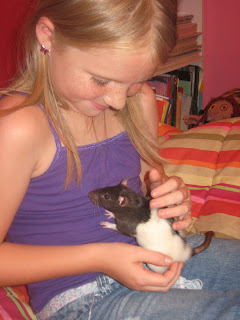
 There was one thing we didn't anticipate about the new pet. One of our dogs, Inara, is very, very fascinated by Adara (yes, we like uncommon names for our pets). We have to be careful not to leave Elena's bedroom door open because Inara will go on there and try to climb up on the desk where the rat's tank is kept. She's not aggressive and doesn't growl, bark, or act like she wants to attack her. She's simply very interested in our new family member.

 Adara sometimes is just as interested, looking out and sniffing at Inara. Unfortunately, I haven't been able to get a picture of that particular scene, as they move away before I can get my camera up! It's a brief but incredibly cute interaction.
My beautiful, wonderful wife has been working on overcoming her dislike of these pets, allowing both me and our daughter to fulfill our dreams and have these non-traditional pets. However, she refuses to have anything to do with them and set the stipulation that Adara is never to leave my daughter's bedroom.
And yes, my daughter's room is VERY pink! Just how she likes it.
Elena gets her passion for exotic pets honestly...I also love them and have encouraged her interest. I have long known rats to be very good pets who are intelligent, generally friendly, and easy to care for. They are my favorite rodent pet, and I find them to be far better than hamsters or gerbils. Unfortunately many people can't get away from the stigmas of rats: they carried the plague-ridden fleas into homes that lead to the Black Death in europe; they are found in sewers, trash dumps, and other unseemly places; they get into grain stores and contaminate them; etc. There is also something about that long, naked tail that people find repulsive. All of this "bad press" makes it hard for people to really look at them and see them for the great pets they can be. Additionally, pet rats are a different species from the rats most people think of as causing disease and problems.
Finally my wife relented, and agreed to allow our daughter to have her own pet rat. However, we required her to save her own money to buy the rat and the accessories necessary. It took some time, but she did finally save her allowance and gift money to the point of being able to get her first rat. A couple of weeks ago we went to the store, picked her out and brought her home.
Adara (named after the main character in the book The Ice Dragon by George R.R. Martin, which my daughter loves) is a real sweetheart. She is everything I could want in a pet rat, being very friendly and handleable. Elena is being a great pet owner, keeping up with food and water, handling her gently every day, and helping to clean out her tank. She is very proud of her little rat, and understands the responsibilities that go with the fun of having a pet.


My beautiful, wonderful wife has been working on overcoming her dislike of these pets, allowing both me and our daughter to fulfill our dreams and have these non-traditional pets. However, she refuses to have anything to do with them and set the stipulation that Adara is never to leave my daughter's bedroom.
And yes, my daughter's room is VERY pink! Just how she likes it.
Subscribe to:
Posts (Atom)