Translate This Blog

Saturday, July 31, 2010

Crooked Beak

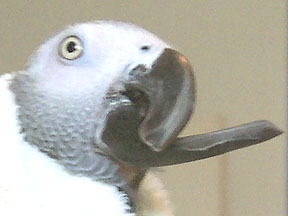
One of my fairly regular patients is a blue and gold macaw with a deviated beak.  This is commonly called "scissor beak" and happens most commonly in larger parrot species.  At some point when they are young, part of the beak grows abnormally, pushing the beak away from the normal middle position.  Over time this becomes worse and worse as the normal wearing of the beak happens abnormally as the upper and lower portions do not meet up properly. Improper beak shape can lead to difficulty eating as the bird cannot grab its food properly.  Here's an example of what this can look like.


In mild or early cases an experienced avian vet can reshape the beak with a Dremmel hand tool, wearing down the long portions to a more normal position.  Though somewhat distressing to the bird, this is actually a painless procedure.  However, when the problem continues for long enough even regular trimming won't be a final solution.  In these cases surgery may be needed for a permanent fix.  Another method is to use acrylic on the beak to gradually force the beak into a normal position.  Once normal positioning is achieved, the shape should be self-sustaining over time.

The macaw I see, Alex, has been coming to me for over a year now, and he's only three.  Though I'm good with birds and other exotics, I'm not a specialist and have been trying to get the owner to go to a local board-certified avian vet to have more advanced procedures done.  Alex has a lifespan comparable to a human, so taking care of this now will help give him a better life in the future.

If anyone knows someone who has a bird with a beak growing like this, make sure they see someone skilled in avian medicine right away.  The earlier that treatment starts, the more successful it can be.

Friday, July 30, 2010

Caution In The Heat

It's been pretty hot where I live, with temperatures in the upper 90s (Fahrenheit), and heat indexes in the low 100s.  Being of Scandinavian blood, I try to avoid being outside at all in this kind of heat, as I quickly feel the effects.  Any yard work is done first thing in the morning before the day has a chance to heat up much.  I also make sure to drink plenty of water and take breaks.

It's in weather like this that veterinarians start to see cases of heat stress or stroke, especially in dogs.  In most cases the pet was left outside in the heat without shade or an ability to get out of direct sunlight.  Access to fresh water is vitally important, but it's the direct, unrelenting sunlight that causes the most harm.  If a pet is kept in an enclosed environment, such as a car, the risk is even greater.  In most cases outside temperatures won't get out of the low 100s to 110s.  However, in a parked car the temperatures can heat up by 40 degrees F within an hour and can get up to 150 degrees; 80% of the increase is in the first half-hour.  And cracked windows don't significantly decrease the temperatures or slow the rate of increase.

Heat stroke can be deadly.  Whatever the cause (lack of shade, being in a parked, car, etc.) core body temperature can rise quickly, getting into critical ranges within minutes.  Very old, young, or debilitated pets are at the greatest risks, as well as those who have dark-colored fur (remember, darker colors absorb more sunlight).  When body temperatures get above 105, proteins can begin to break apart and brain cells can die.  I've seen pets come in with temperatures that are above the normal range for a thermometer (generally meaning 106 or higher); most of those didn't survive.  When body temperature get this high, even if a pet survives there can be permanent brain and organ damage.  Besides the immediate danger of brain damage, there can be other serious concerns that may not show up until a day or two later.  Simply put, overheating can be deadly.

This is an entirely preventable problem!  Don't EVER leave your pet in a car.  There have been cases of death when outside temperatures are as low as in the upper 60s (remember...around 40 degree increase means that at 67 outside the inside temperature can get to 107).  I don't care if you crack a window, put the sun shade up, or take other measures.  DON'T leave your pet outside in a car for even a few minutes.  If you come back and your pet is dead or in serious condition, YOU are the one who did that.  Also, don't ever leave your pet outside without any way to get in the shade and out of direct sunlight.  If you have a shade-free yard, don't leave your pet outside for more than a few minutes, and keep checking on them regularly.

Take care of your pets in hot weather.  They may be in situations that they can't control but we can.  Be aware of these circumstances and you can prevent serious harm or death.

Saturday, July 24, 2010

Rules For Visiting The Vet

I saw these posted on a work-related forum, and thought that I would share them here. All veterinary staff will immediately understand these things. For the non-vets reading this, you may see some of yourself in this. It's all in good fun.

Rules For Visiting A Vet
1. Do not make an appointment. Just walk in, because they are going to be there anyway. Demand to be seen immediately! Become irate if you have to wait for anyone who was there ahead of you.
2. Bring your children, bring your neighbor's children. If you have no children, borrow some from a friend.  Toddlers who have been walking for less than a year are best. If they are talking let them run around all over the hospital to ask everyone on the staff questions.
3. Place your pet on the exam table, then sit down. Please do not hold it. Emphasize that "It won't jump down!" and "It NEVER bites!"
4. Please ensure your mobile phone is turned on when you enter the consult room. Get as many people to phone you to find out what is happening to your dog/cat. Spend at least 10 minutes discussing this with them as well any other personal matters that come to mind.
5. Do not remove your sunglasses, especially if you have a hearing problem.
6. If you have a concern, YELL at and abuse the receptionist, then when you see the doctor, be as sweet as possible.
7. As you leave, let your un-neutered dog urinate on every stationary object until you get outside. Do not tell anyone.
8. Please tell us if there is a problem, but wait at least 3 weeks to do so. Remember, continuous diarrhea for four weeks or more is considered "An Emergency Situation!". This is especially true at closing time on the weekends.
9. If your pet is in really bad shape, tell the doctor that you have been on vacation. If you haven't brought your pet in to the hospital in two years, always tell the doctor the problem started RIGHT after the last visit and hasn't gone away.
10. Have your record under as many last names as possible. For your pet, have a registered name, a baptized name, and a nickname for each family member. Use a different one each time you come in for a visit.
11. When leaving your pet for boarding or any other procedures, never tell anyone in the office that you have changed your phone number since your last visit.
12. Never say anything important until the doctor put his/her stethoscope to their ears.
13. Always say, "Cost is not important! Just save my pet!" until you get the bill, then deny that you said it was OK to treat. Make a big fuss over every item even though you are not going to pay anyway.
14. Always bring your checkbook without any checks in it or leave home without your wallet. Only carry hundred dollar bills when you do bring it, especially if you are only buying one can of food.
15. If possible, always send your pet to the clinic with your children under 18 years of age with no money or credit cards. Never tell them why they are bringing the pet in.
16. When in consultation with the vet, do not talk to them directly, but rather baby talk to your pet about their symptom-wymptoms.
17. Always dismiss anything the vet nurse tells you regarding your pets treatment plan because "you're not a doctor". Argue intensely, use as many curse words as possible. When the vet comes and tells you the same exact thing, deny that the nurse told you anything or tried to explain something to you.
18. If you can come in wearing a negligee and fluffy slippers, full hair and makeup at 5am (after making vet wait an hour so you could do said hair and makeup), we would be really appreciative.
19. Make sure to emphasize that you used to breed German Shepherds...pause...and then say with great emphasis...WHITE German Shepherds. Then stand back and wait for the nurse to fall over because she's so impressed.
20. Complain about the cost of EVERYTHING. Stating that if you went to your doctor, you could get such and such procedure done for $100. Or that you will have to just "put your pet down" because you can't afford our prices.
21. Make sure you call an hour before closing to ask about having something done quickly (ex: express anal glands). Then, when you come in 20 minutes before closing, mention the huge list of other things you want to have looked at "since we're here anyway."
22. Make sure to never bring your dog in on a leash. It is best to let them run arround the parking lot and lobby without one. There is no need to be concerned about injury by cars or other pets.
23. Our Doctors' recommendations should not be heeded under any circumstances. They are just trying to con you out of your hard earned money. Feel free to waste an hour of out time and then decide you will take your pet home and "observe" him/her because you definitely know what is best.
24. When you believe that your pet may be in need of medication, it is not necessary to bring him/her in. Just call us on the phone and describe the injury/symptoms and we would be happy to diagnose the problem and prescribe medications for it. Of course, there will be no cost to you for the medicine, since your pet is not even our patient.
25. If your pet has eaten any type of contraband item that was within it's reach in your home, it is best to lie to the doctor to avoid having anyone know that you were in posession of said item. The doctor will still be able to save your pet's life without knowing exactly what is wrong.
26. Our Doctors have no need for a lunch hour, nor do they have any desire to spend time with their families after business hours, as our Doctors are not human but lifeless robots. Feel free to come in or call any time of day and expect the doctor to spend any amount of time you desire to talk to you about your pet's new accessories, new hairdo, or her latest outing to the dog park.
Thursday, July 22, 2010

Is It Worth It?

Jessica sends in this timely question...

I came across your veterinary blog the other day when I was searching the internet, and I happened across a post discussing if you could do everything over again would you go to veterinary school again? From the post it sounded as if there were many times when you regretted your decision for various reasons. The reason I am emailing you is that my situation is unique, I had planned on being a veterinarian most of my life (I love animals and come from a family of professionals), but ended up switching for various reasons (e-calls and long hours being one reason) to optometry once I got to college. To make a long story short I got accepted to optometry school and not long after decided that it wasn't everything I thought it was, and thought that I would really miss not having any animal interaction. Unfortunately I was already in the middle of a large amount of school debt and decided I better finish my degree so that I would have a way to pay off my debt in case vet didn't work out for some reason. I am now in my last year and will graduate this coming May. I am in the process of deciding if I want to apply for vet school this application period. I am now spending time shadowing vets on the weekends to try to make a decision about if veterinary is something that I really want to pursue. (I don't want to get another expensive, time-consuming degree, if I am not 100% sure this time). I am trying to get all the opinions and viewpoints on the career I can, which is why I am emailing you.

Unfortunately when I was shadowing optometrists before I applied, they all made it sound like the perfect career, and didn't talk about any of the downsides. As with any job optometry has plenty of downsides, including e-calls and a very repetitive nature. If you get a chance I would be interested to hear why you often regret your decision. I know in your blog you said that you wouldn't be the person you are without the career. I can understand that, but disregarding everyone you've met etc. because of the career, would you still become a vet again?

 My main thing is that I like the science etc. behind optometry ( I like diagnosing, treating, ocular disease etc.), I just miss the fact that there is no animal interaction, and optometry tends to get very repetitive/boring very fast. I know its a good career overall, but I know as an optometrist I will never look forward to going into the clinic everyday, and will count down the hours until I get out at the end of the day. Do you enjoy going into work as a vet everyday, or is it just a job? I get annoyed if I have to stay late for patients in optometry, and I know that every pet has an owner and that there is a lot more people skills involved in veterinary that most people think, but I feel like staying late for an animal would be much more tolerable.

I would really appreciate if you wouldn't mind giving me your insight into the career without any sugar coating. Any viewpoints help, since I don't want to put myself into more debt and take 4 more years of my life getting a degree that I just find mediocre once I'm done.

I've actually been putting off answering this letter because I wanted to make a more objective reply.  However, this week I've had cranky clients and aggressive pets and haven't reached that point.  So I thought rather than delaying further I'd give an honest answer.  Now there are several points to reply to, so I'll take each one in turn.

First of all is the financial reality.  Jessica, if you're already in a lot of debt, it wouldn't be a good idea to go straight into veterinary college.  The average debt load of a newly graduated vet is quickly pushing $90-100,000, and the average starting salary is around $55,000.  Now total your existing debt from ophthalmology school and see if you can live off that salary.  You'll be spending thousands of dollars each month in loan repayments, making basic living a challenge.  In fact, this is one of the biggest problems facing veterinary medicine right now, as we have a higher debt-to-income ration than any other medical professional and it's only getting worse.  Veterinarians make about 1/3 of what a physician with the same experience will make.  You have to be realistic about this and decide if you can make your loan repayments after graduation, keeping in mind that even a bankruptcy filing won't eliminate student loans.

Staying late for animals can be just as annoying as staying late for humans.  When you've been working a 10+ hour day, you just want to go home, relax, and spend time with friends or family.  No job is more important that your loved ones, and a veterinary career can interfere with it just as much as any other medical job.  Believe me, you'll get tired of those clients who come in at the last minute for "sudden emergencies" that have been going on for a week and could have waited until the next morning.  As you stated, you'll be dealing with people just as much as you would in any other aspect of medicine, and they're the ones that will annoy you regardless of what field you're in.

Being very honest and blunt, this is a job to me.  Almost every day I'd rather be anywhere else than at work, and enjoy the days when I don't need to be there.  Now there are certainly things I enjoy about being at work, and it's not like every single moment is dreadful.  I started feeling this way about three years into practice, and it hasn't improved in the 10 years since then.  I still get excited about certain things, and do have fun with my staff.  But yes, this is a way to pay bills and put food on the table, no longer a calling or something I'm very passionate about.

Taking away every other aspect of my life and who I am?  Well, that's hard to do, as I am who I am today because of what has happened in my life, including my job.  But if I could wave a magic wand and keep everything the same except for my job, would I still be a vet?  Truthfully, no.  I have discovered that my passion lies much more in teaching than in practicing medicine.  If I had to do it all over again, I'd likely take a course to being a college professor.  Yes, I know this had its downsides also, as I've actually taught at a local college.  But that job was the best one I've ever had, even with the challenges and hassles.  I hated leaving it and going back into practice.

Jessica, please realize that I am very much in the minority in my opinions.  I read a study several years ago that looked at job satisfaction among US veterinarians.  Only about 20% didn't like their career choice, and 80% were satisfied or very satisfied with their job.  There are a lot of great things to be said about being a vet, and it can be an excellent career choice.  I wouldn't want you to avoid becoming a vet on my opinion alone if this is your true passion.

Pros:  Good salary compared to many professions.  Respect from most people (surveys have ranked vets in the top 5-10 professions that people trust most, and above any other medical professional other than nurses).  Interesting and varied cases.  Great interaction with animals.  Lots of career options.  Most vets find it to be a true calling and a satisfying job choice.  Great intellectual challenges.  Opportunities to own your own practice (if this interests you).

Cons:  Low salary compared to debt load.  Often long hours.  Risk of physical injury every day from aggressive animals.  Having to be responsible for life-or-death decisions.  Having pressure to be perfect every time in every case.  Sometimes difficult clients.

Jessica, I hope this helps in your decision, though I strongly advise you to continue to get lots of opinions.  I'm sure some of my veterinary readers will chime in with their own opinions, which are always welcome.  And hopefully I haven't tarnished my image to my readers, as there are still many interesting things to share about the realities of life as a veterinarian.

Sunday, July 18, 2010

The Other Half Of A Vet

For the past couple of years I've talked about life as a vet.  However, there is another half to me...my wife.  Most vets are not married to other vets and those spouses have to put up with a lot of things that they probably never expected.  I've been married to my sweetheart for almost 12 years, and she's had to deal with some pretty odd things.  She also isn't a science-based person, having majored in English and minored in Drama.  She has a pretty weak stomach and doesn't like "creepy-crawlies".  In fact, when she saw the cuterebra picture from last week she became nauseous, and couldn't even come close to watching the videos.  Here are some other things my wife has had to deal with....

*  Trying to get blood, feces, urine, and other unseemly things from my clothes.
*  Hearing me casually talk about abscesses, surgeries, and other gross things while we are eating dinner.
*  Coming to visit me at work and seeing me in the middle of a surgery. (Remember that weak stomach of hers?)
*  Seeing me struggle with life-or-death decisions and worry about it the whole time.
*  Having me call at the last minute and say that I won't make it home for dinner because of a last-minute emergency.
*  Having me leave in the middle of the night because I was called in for an emergency.

Veterinary spouses often have to put up with even more things, especially those married to large animal vets.  There's nothing quite like having to help give birth to a calf or see your spouse carried away in an ambulance because they were kicked by a horse.  Spouses also have to give support and comfort when things go wrong and a patient dies.  I know that my wife has helped me on untold occasions.

So I just want to give a big "shout-out" and thanks to the husbands and wives that support their veterinary spouses.  It's not an easy job and we're glad that you do it.

Thursday, July 15, 2010

Aggressive Dog Problem

Reader Rockjdog asked this question...

Question for you. One of my dogs is very aggressive. When I first got her from a rescue a little dog (off leash) got in her face and she bit the dog. The dog died on the way to the hospital. (Severed artery).  So I have discovered she is very aggressive to all animals. She goes bonkers when she sees another dog. Last week she caught a full grown ground hog. She carried it and shook it for a good 20 minutes. No matter what I did she would not let go.

She is 125 lbs and my other dog Rock is 175 lbs so it is very hard to walk them together. Rock is fine but Molly can get very excited.  I have been to two trainers and have done the work they suggested but she still remains very hyper when it comes to other dogs.

She has had blood work done and she is fine.  Do you think it might be helpful for her if I approach my vet about trying some SSRI's for her? Do you think they work on dogs? I have not heard too much about them with animals but it seems to be an over-looked drug fro behaviour or fear issues.


This is a pretty serious problem, and one I would really look into.  You could be at risk for a lawsuit, as you are legally responsible for any harm your dog does.  Be very careful with Molly because of this.

Animal behavior is a very strong interest of mine, and I consider myself good at it.  Even so, I will often refer cases of aggressive pets to specialists because of the liability and potential danger involved.  I would highly recommend that you seek out a veterinary behaviorist and not just a trainer.  Follow this link to the American College of Veterinary Behaviorists where you can find a diplomate near you (sorry, I don't have references outside of the US).  As big as your dog is, a veterinary behavioral specialist is going to be your best resource.  A trainer is the equivalent of a therapist, or perhaps even a psycologist.  A board-certified behaviorist is the equivalent of a psychiatrist, as they are doctors and can prescribe medications.

Any therapy for behavioral problems always requires behavioral modification therapy.  Such treatment is the cornerstone of changing a pet's behavior.  Medications can be added to the regimen to help alter the behavior but should never be used alone.  Veterinarians who aren't well trained in behavior will sometimes prescribe medications and not talk about modifying the behaviors or other training methods.  If you talk to a vet and they only discuss medical therapy, I will be blunt in saying that I would not fully trust their judgment on this topic.  Every specialist I have ever heard speak, as well as every article that I have ever read, have always emphasized drugs as an aide to therapy but not the sole part of therapy.

There are two broad categories of behavioral medications:  selective seratonin reuptake inhibitors (SSRIs) and tricyclic antidepressants (TCAs).  A few medications may fall outside of these classifications, but most can be broken up into one of these two fields.  Researchers are still trying to understand all of the ways that these medicines work, so there are still some aspects that are not understood about their mechanisms of action.  Simply put, these drugs generally help reduce anxiety and increase the feeling of "well-being" in the patient.  They don't necessarily reduce aggressive tendencies, but instead can work to lower the anxiety, stress, or fear that leads to aggression.  If a drug out of one category doesn't seem to work, a choice from the other category may be more effective.  It's also important to remember that these medications can take anywhere from 2-4 weeks to show effectiveness, so a few doses won't make a dramatic difference.

Take care of this as soon as possible.  I hope these suggestions help!

Wednesday, July 14, 2010

Spammers Must Die

Over the last few weeks I've been having more and more spammers post comments with links to outside web sites.  Up until now I've simply deleted these comments as soon as I noticed them, but my frustration has been building.  I already have the comments set up where you have to manually enter a code to help prevent bots from posting automatically.  Apparently the bots have found a way around this or some of the spammers have determined that they should spend their time hunting down small blogs like mine and posting links to unrelated and sometimes offensive sites.

Well, I'm going to have to put a stop to that.  For the time being I'm going to have to approve all comments posted here.  I'm not a fan of censorship and welcome any opinions contrary to mine (as long as they are posted intelligently and respectfully), so I'll continue to make all non-spam comments public.  But be aware that any comments made will have to go through my email so I can better weed out (and hopefully report) spammers from this blog.

Frankly, I don't see why they do this.  I know it may increase traffic on their site, but this is annoying throughout the internet, and usually results in getting banned or blocked.  Yes, it must be worth their time or they wouldn't do it.  But whatever happened to common courtesy and respect?  Obviously, they don't have it.