Translate This Blog

Wednesday, August 11, 2010

A Time Bomb--Atlantoaxial Problems

 I had a rather scary problem today, and one I've faced before.  A terrier-mix had been having mysterious pain for a week or more.  Another vet had taken radiographs and noted extensive fusing of many vertebrae in the spine, a condition called spondylosis.  This certainly can cause pain, and I've seen those cases before.  The dog was placed on two analgesics and sent home for observation.  Unfortunately the pain didn't go away.  The owner thought it was in the neck and not the back.  Ironically, the only part of the spine that the other vet didn't get images of was the neck.  It was also puzzling because the pain wasn't consistent or repeatable.  When I examined the dog I manipulated the neck without any problems, resistance, or pain.

I've begun to appreciate modern technology in aiding a diagnosis, but not in the way many might think.  One of the keys to this case was the video the owner took with her digital camera.  Since the pain was sporadic and mainly happened at night, she took the video so a vet could see what was going on.  The dog's posture and actions certainly seemed to indicate neck pain.  But without symptoms in the clinic, this was puzzling.  Well, we knew a problem was in the neck, so we took x-rays of that area.

When I looked at the film my breath caught.  The problem was immediately obvious and was a serious one.  This is an image of the neck of a normal dog.
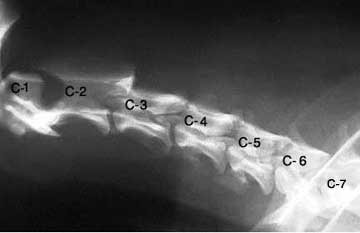
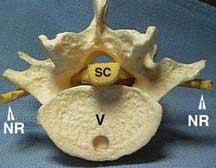
The first vertebrae (here labeled C-1) is the atlas and the second one (C-2) is the axis.  The atlas articulates with the skull and supports the head.  Most of the mobility of the head is going to come from the interactions of these two vertebrae with the skull.  In the center of the vertebrae is a hollow tunnel through which the spinal cord runs (labeled "sc" below).  In the above image the spinal cord would run where the letters and numbers are.
This dog had a severe dislocation of the atlas and axis.  Below is an image from the 'Net and not from this case, but my patient was very similar.
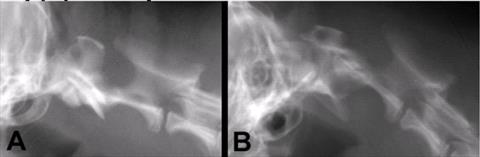

The left image is normal and the right one shows atlantoaxial subluxation.  Pay careful attention to the center of the vertebrae where the spinal cord would run.  The displacement of the vertebrae bends the spinal cord and puts pressure against it.  This can cause pain and was the source of our problems.

The scariest part of this is that this dog is a ticking time bomb.  At any time the dog's neck could shift more severely, immediately causing damage to the spinal cord.  This can cause paralysis from the neck down, but more importantly can cause problems with the heart and respiratory system since the nerves controlling these vital organs run through the neck.  I've seen a couple of cases like this and have always shuddered when I saw the radiographs because of the potential harm that could have happened during the exam.  When a patient has neck pain we will manipulate and bend the neck in all directions to see if we can isolate where the problem is.  Unfortunately in this case that manipulation can damage the spine.

Thankfully, this is a treatable problem.  Surgery can be performed to place pins or plates between the vertebrae once they are realigned, keeping them from moving out of place again.  Patients normally do well after this surgery and can lead normal lives afterwards.  This dog has an appointment with a surgical specialist and will hopefully have the procedure done soon before this particular bomb goes off.

Monday, August 9, 2010

A Night At The Museum

In my area we have a local science museum, the Tellus, that has some cool events.  Most recently they hosted their second annual "Night At The Museum".  The premise was very similar to the movies of the same name.  Various displays of historical people come to life at night and interact with the museum visitors.  My wife and I participated as Jules Verne (me) and Amelia Earhart (my wife).  Other people portrayed figures such as Henry Ford, Galileo, Marie Curie, the Wright Brothers, and Nicola Tesla.  For the entire night we acted in character, pretending we were the various characters come to life.  Since we were really "museum displays" we would periodically have to freeze in place as if we were manikins.  There were also two people dressed as security guards and when they approached we would have to immediately become frozen. The guards really played up on this, dusting us off, shining flashlights in our eyes, and interacting with the guests.

Most of this was designed for kids, but the adults seemed to enjoy it as well.  We would educate people about the lives and accomplishments of our characters, sign autographs, pose for pictures, and otherwise enjoy ourselves as we did a lot of in-character improvisational interaction.  I've always loved Verne's stories and enjoyed learning more about his life (he was born on February 8th, the same birthday as my father...he was friends with Alexander Dumas...he was a stickler for scientific accuracy in his stories).  My wife has always been fascinated with Earhart and jumped at the chance to pretend to be her.

All of this was a big success, and it seems pretty certain that the Tellus Museum will do it again next year.  If they do, I'm certainly going to participate again!

My lovely wife as the spunky Amelia Earhart.  Unfortunately you can't tell as well in this photo, but she looked really good.

She's second from the left here.  "Sally Ride" is in the blue jumpsuit in the middle with Henry Ford in the trenchcoat next to her and Tesla just to the right of him.

Me as Jules Verne signing autographs.  I'm next to a model of the interior if the earth, purposefully done because of Journey to the Center of the Earth.

One of the guards making sure everything was okay with the Verne "manikin".  I had to try and remain completely still and worked not to blink very much.  There was one time where I was motionless for over five minutes and my contacts began to dry out.

Here I am next to Madame Marie Curie, Albert Einstein, a miner, and a chemist.  Some people played non-specific characters such as chemists, paleontologists, and so on.

Okay, so none of this was related to veterinary medicine, but it sure was fun!

Thursday, August 5, 2010

An Emergency Repair

Being a vet can teach you unexpected skills and bring unexpected dangers.  Here's a typical case....

Last week one of my techs was trying to restrain an unruly dog.  He wasn't aggressive, just very wiggly and didn't want to stay still.  We did what we needed to do with him, but she had difficulty getting him still enough and he kept trying to get out of her hold.  She managed to pick up a few new bruises and some minor scratches.  But one of the worst things that happened was that the dog got a foot in the pocket of her scrub top and tore the stitches from a corner.

Okay, so it wasn't a life-threatening problem.  And it was only the corner of the pocket.  But that's where the unexpected skills came into play.  I didn't want her to spend the rest of the day with a dangling pocket, so I got to work.  I've removed spleens, kidneys, and bladder stones and do surgery several days per week.  So I pulled out a pack of suture, some needle holders, and started a "laceration repair".


Dark purple suture doesn't show up well against navy blue scrubs, so it isn't easy to tell.  A simple continuous suture line and a few minutes later and the pocket was as good as new.  And believe it or not this isn't the first time I've performed this particular procedure.  I've sutured my lab coat pockets on more than on occasion.

Yet another unexpected life skill learned by being a vet.

Wednesday, August 4, 2010

Bye-Bye Eye

Most of the surgeries veterinarians perform are spays and neuters and are very routine.  But it's not uncommon to do more advanced and uncommon procedures.  Monday was one such surgery, as I removed a dog's eye, a surgery called "enucleation".

The dog is an old poodle who had a history of eye problems.  His left eye had been injured many years ago and was shrunken and useless.  His right eye had developed a cataract, so he was essentially blind.  Last week the right eye suddenly became worse and the eye protruded.  Apparently the globe (eyeball) had slightly popped out and the eyelids had slid behind it, trapping the eye in front of the lids.  Infection developed and this was extremely painful.  There was no saving the eye so the decision was made to remove it.

**WARNING!!!!!**  If you're squeamish don't scroll down through the rest of the blog.  I'm posting some pretty graphic images.


This is what the eye looked like just prior to surgery and after shaving and surgical prep.  He is already under anesthesia at this point.


The cloudiness of the eye is a combination of cataract and pus.  The dog was completely blind, so the eye was only causing discomfort.  There was also severe damage to the eye so there wouldn't have been any benefit to putting it back into position.  The surgery is actually not very difficult and can be done by most general practitioners.  It's simply a matter of carefully cutting the muscles and connective tissues, gently freeing the globe from its attachments.  After cutting the optic nerve at the back of the eye, the globe comes out easily.


The last photo is of the empty socket after the globe has been removed.  The third eyelid and tear gland are removed and then the edges of the eyelid are cut away.  The eyelids are sutured closed so that the socket and tissues are protected.  In some cases a false eye is placed in the socket, but most vets don't do this and it is purely for appearances with no medical benefit.  Here's a picture of the patient after the surgery was finished.


Dogs do quite well after the surgery and will go home with antibiotics and pain control.  Sutures will come out in 7-10 days and by then they are usually back to normal.  Since this kind of surgery is done because of severe damage to the eye, the dog is already blind prior to surgery, so removing the eye only improves their quality of life.

Tuesday, August 3, 2010

Who Knows Best?

A reader made this comment on another topic, and I thought it was worth addressing.

Except my vet doesn't think that I am smart enough nor know my pet well enough to hold it for him!!!Buddy, I know MY dog. And yes, he might snap. I'm no pushover, if you know what's best for you, you'd best let me doing the holdin'!

Not to be rude, but this is absolutely the wrong attitude to have.  Most veterinarians won't let owners hold their pets because of safety, not because we don't think an owner is smart enough.  In fact, I will generally refuse to see an aggressive pet if the owner won't let us restrain.

There are certain ways to properly hold a pet, and certain ways not do.  This is important for the safety of the pet as well as the safety of anyone around them.  If a person isn't restraining properly both that pet and anyone nearby could be injured, potentially even severely.  Veterinarians and their staff undergo training to use proper restraint techniques and have extensive experience.  When one of my staff isn't doing proper restraint, I'll work on correcting them, and all of my experienced staff are extremely good at safely keeping pets from harming anyone.  I'm sorry for any hurt feelings, but very few pet owners have this kind of training. 

Now this isn't true of all pet owners.  I do have some that I will allow to do part of the restraint.  However those are the exception rather than the rule, and if the pet is really trying to bite or scratch I'm going to trust my staff far more than I'm going to trust a client.  And if it means losing that client because they won't let us do the restraint, I'll wave bye to them as they leave.

Besides safety, there is a major liability issue for the vet.  People have sued and won because they were injured by their own pets during a veterinary visit.  And don't say "well, I wouldn't sue if that happened."  I have read reports from the AVMA liability insurance where a client would refuse to let the veterinary staff hold their pet and insist on doing it themselves even knowing the risk.  The pet then injured the client (despite warnings from the vet) and the client turned around and sued the vet because the vet should have known better and not let them do it.  I've seen examples of this numbers of times, so it wasn't an isolated incidence.  I'm not willing to risk my license and my livelihood to prevent someone's hurt feelings.

So if you come into my office and your pet might bite, be prepared to let us hold it. 

Sunday, August 1, 2010

Updating

This past month I put up a non-veterinary poll out of curiosity.  Though I don't get paid for this blog, I try to update frequently to keep people interested.  However, since I don't get paid I also sometimes don't feel much motivation to post daily.  For the most part this is done for fun and not profit.  Even so, I know there are some regular readers and I don't want to disappoint too much.  So how often do people like their blogs to update?  Based on the results, fairly frequently!

Daily--35%
2-3 Times Weekly--52%
Weekly-9%
2-3 Times Monthly--3%
Once Monthly--0%

Most months I average around a post every other day, so it looks like I'm keeping it in the area of the top two choices.  Obviously the more important part is that the posts are entertaining and informative, rather than just frequent.  Quality is better than quantity.

A few more stats about the site.  A year ago I started tracking hits to the blog.  In that time there have been over 30,000 individual views, which has averaged to around 84 visits per day.  There are also 25 regular followers.  The blog has been read by people on every continent except Antarctica and in every hemisphere.  I find all of that interesting for a small-time blogger like myself.

So thanks to everyone for reading the blog.  Since I want this to be interactive, I'm always open to suggestions of topics and get excited when I get questions from readers.

Saturday, July 31, 2010

Crooked Beak

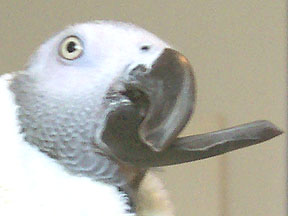
One of my fairly regular patients is a blue and gold macaw with a deviated beak.  This is commonly called "scissor beak" and happens most commonly in larger parrot species.  At some point when they are young, part of the beak grows abnormally, pushing the beak away from the normal middle position.  Over time this becomes worse and worse as the normal wearing of the beak happens abnormally as the upper and lower portions do not meet up properly. Improper beak shape can lead to difficulty eating as the bird cannot grab its food properly.  Here's an example of what this can look like.


In mild or early cases an experienced avian vet can reshape the beak with a Dremmel hand tool, wearing down the long portions to a more normal position.  Though somewhat distressing to the bird, this is actually a painless procedure.  However, when the problem continues for long enough even regular trimming won't be a final solution.  In these cases surgery may be needed for a permanent fix.  Another method is to use acrylic on the beak to gradually force the beak into a normal position.  Once normal positioning is achieved, the shape should be self-sustaining over time.

The macaw I see, Alex, has been coming to me for over a year now, and he's only three.  Though I'm good with birds and other exotics, I'm not a specialist and have been trying to get the owner to go to a local board-certified avian vet to have more advanced procedures done.  Alex has a lifespan comparable to a human, so taking care of this now will help give him a better life in the future.

If anyone knows someone who has a bird with a beak growing like this, make sure they see someone skilled in avian medicine right away.  The earlier that treatment starts, the more successful it can be.